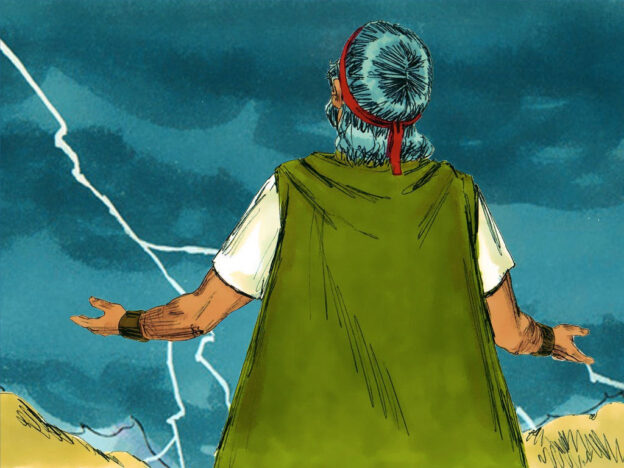
So I said to them, ‘Whoever has gold, take it off’; so they gave it to me, and I threw it into the fire, and out came this calf!”
Exodus 32:24
Dear members and friends,
After destroying the golden calf, Moses confronts Aaron and asks what the people did to bring about such a great sin. Aaron explains that he threw their gold into the fire and concludes, “Out came this calf!” (Exodus 32:24). However, the calf could not have simply appeared. It was fashioned through deliberate intention and actions. Yet Aaron describes the result as though it happened almost by itself.
Aaron’s response illustrates a familiar human tendency: when our choices lead to consequences we regret, we often explain them in ways that reduce our responsibility such as “I don’t know how, but it kind of happened!” The Israelites were anxious about Moses’ absence, but their anxiety did not compel them to create an idol. Spiritual growth begins when we stop treating our old habits as things that simply happen to us and start examining the choices through which we sustain them.
The remainder of Exodus 32 describes the people’s confrontation with their wrongdoing and the severe consequences that follow. The golden calf cannot remain among them as if nothing happened. This helps us understand repentance. Repentance is not merely feeling sorry for something we have done. Real repentance involves turning away from the loves and intentions that led us toward it.
If impatience causes us to abandon our commitments, we must examine why we demand immediate reassurance in the first place. If the desire for control leads us to manipulate others, we must examine why we struggle to respect the freedom of others. In Arcana Coelestia, Swedenborg connects the golden calf with the human tendency to make our own understanding and desires the source of what we regard as good and true. From this perspective, repentance involves learning to receive goodness and truth from the Lord rather than treating our own desires as the final authority, which is true humility.
We cannot overcome the golden calf simply by deciding never to make another one, because what the golden calf symbolizes is less of a happening, but more of a tendency. We must, therefore, recognize the fears and self-centered desires that made it attractive to our minds. Spiritual transformation requires more than eliminating what is wrong. It also requires redirecting what caused the misdirection. We can seek security through a deeper relationship with God rather than the illusion of controlling life. We can pursue truth with humility rather than using it to justify ourselves. We can build community through mutual care rather than shared fear.
The Israelites had been liberated from Egypt, but they still had to discover how much of Egypt remained within them. The journey from fear to trust and from self-centered desire to love unfolds through the difficult work of learning, recognizing, repenting, and beginning again. When we discover another golden calf within ourselves, we need not despair. We can face it with honesty, humility, and hope, allowing the Lord to lead us beyond the familiar security of our own making. The purpose of the spiritual journey is not to prove that we have never made an idol. It is to become willing to recognize our idols, turn away from them, and invite the Lord to lead us into a new life.
Blessings,
Rev. Junchol Lee