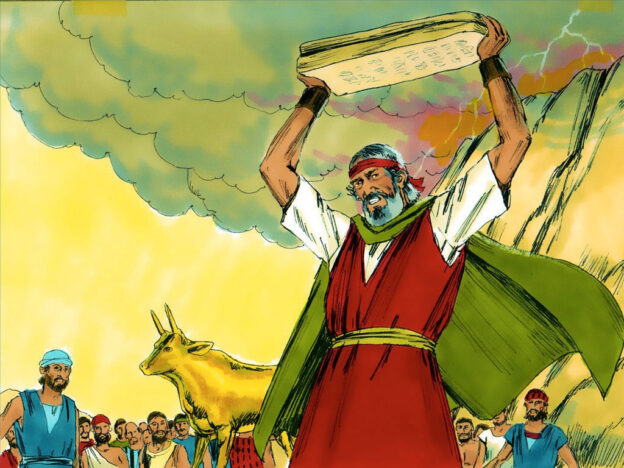
Then Moses turned and went down from the mountain, carrying the two tablets of the covenant in his hands, tablets that were written on both sides, written on the front and on the back. The tablets were the work of God, and the writing was the writing of God, engraved upon the tablets.
Exodus 32:15&16
Dear members and friends,
The Israelites made the golden calf almost right after making the covenant with God. While Moses was present with them, they proudly declared, “All that the Lord has spoken we will do” (Exodus 24:3). However, when Moses remained on Mount Sinai longer than expected, the covenant with God faded away from their minds, perhaps because it was not in their hearts yet. Their failure reveals a familiar human challenge: the distance between the promises we make in moments of clarity and the choices we make when those promises become inconvenient. We may sincerely promise to become more patient, yet return to impatience when frustrated. We may commit ourselves to honesty but compromise our principles when the truth threatens our interests.
When Moses descends the mountain and sees the calf and the dancing of the people, he throws down the tablets and breaks them at the foot of the mountain (Exodus 32:19). The tablets, which were made by God, contained the commandments that were to guide the people’s relationship with God and one another. Their breaking dramatically expresses the rupture between the covenant the people had professed and the lives they were actually living.
In Arcana Coelestia, Swedenborg explores the danger of separating external religious forms from their inner spiritual meanings. Religious knowledge and worship cannot fulfill their purpose when they are disconnected from a life of goodness and truth. The question is not simply whether we possess the truth, but whether the truth is experientially transforming us, thus our lives become in accordance with the truth.
Before Moses descends, God tells him of the people’s betrayal. Moses responds by pleading for Israel, appealing to God’s covenant with Abraham, Isaac, and Jacob. This conversation between God and Moses illustrates a tension between judgment and mercy. The people’s actions cannot be dismissed, yet their failure need not be the end of their relationship with God. From a Swedenborgian perspective, divine wrath described in Exodus 32 should not be understood as God’s anger. The Lord is incapable of being angry and thus continually seeks the good of humanity. However, people experience the unpleasant consequences of turning away from divine order as the judgment of God. The mercy of God does not change the fact that our choices have due consequences. What it truly means is that our failures do not eliminate the possibility of restoration with God.
Swedenborg’s understanding of regeneration emphasizes that spiritual growth means the gradual reordering of our loves. We must do more than acquiring religious knowledge; we must allow our motivations and actions to become consistent with divine order, that is the union of goodness and truth in our lives. The broken tablets remind us that our commitments can be violated. Moses’ intercession reminds us that our failures need not be final. When we discover our own golden calves, we can examine the fears and desires behind them, accept responsibility, and have courage to begin again. Divine mercy does not erase the truth about our current condition. It gives us the courage to face that truth and move forward with the work of transformation.
Blessings,
Rev. Junchol Lee