
Deliver my soul from the sword, my life from the power of the dog!
Psalm 22:20
Dear members and friends,
A simple question has been in my heart since I started reading and learning Swedenborg’s correspondence: “Why did Swedenborg give such awful meaning to dogs?” Afterwards, I have been contemplating a different question, “Can dogs have more meaningful symbolism?” These questions stayed in my heart simply because I love dogs.
In his Arcana Coelestia #7784, Swedenborg explains:
“A ‘dog’ signifies the lowest of all, or those who are of small value in the church, likewise those who are outside of the church, also those who prate much about the things of the church and understand little.”
In my understanding, this meaning was attached to dogs not necessarily because of what dogs are in themselves, but because of how dogs were generally regarded and experienced in the biblical world. Dogs in the biblical world were often associated with scavenging, uncleanness, wildness, and life outside the household. Their cultural role was therefore quite different from that of the modern companion dog.
This leads me back to Swedenborg’s more fundamental principle of correspondence. In Divine Love and Wisdom #52, he writes:
Every single thing that comes to light in the created universe has such an equivalence with every single thing in us that you could call us a kind of universe as well. There is a correspondence of our affective side and its consequent thought with everything in the animal kingdom.
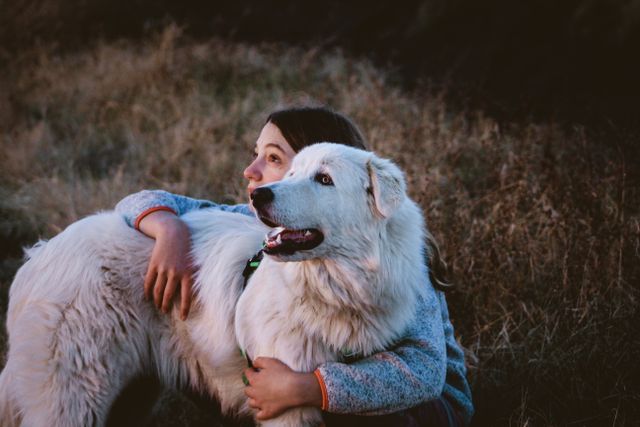
If the animal kingdom corresponds to our affections and thoughts, perhaps we should ask not only what dogs meant to people in the biblical world, but also what qualities of affection dogs embody in human life today. For many people today, dogs represent faithfulness, companionship, devotion, trust, loyalty, joy in relationship, protection, watchfulness, affection, mutual care, and the ability to bring people out of isolation. A dog can become a companion through loneliness, a reason to go outside, and a living expression of attachment and care. This is particularly noticeable in modern urban life. In a city such as San Francisco, where many people live alone or experience the anonymity of urban life, dogs can become significant companions and sources of relationship.
If these qualities are also expressions of human affection, then perhaps the correspondence of the dog can be expanded. A dog might represent natural affection expressed as loyalty, companionship, protection, and faithful attachment. Yet these same qualities can have a negative form. Loyalty can become possessiveness; attachment can become dependence; protection can become aggression; instinctive affection can become indiscriminate appetite.
In this sense, perhaps Swedenborg’s negative correspondence does not have to be discarded. It can be understood as one particular aspect of the dog: affection that remains at the natural or external level and has not yet been joined with spiritual understanding. Perhaps, then, we should not ask simply, what does the dog mean?” Instead, we should ask: “What kind of affection is the dog expressing here?” That question may lead us closer to the deeper principle of correspondence.
My brothers and sisters in God, let us take a moment of reflection this week. Let us contemplate our relationships with our animal friends and family. Perhaps, it would be helpful to deeply reflect on whether we are giving to them as much as they are selflessly sharing with us.
Blessings,
Rev. Junchol Lee