The Story of the Golden Calf: Inconvenient Moment of Acknowledging One’s True State of Being
When the people saw that Moses delayed to come down from the mountain, the people gathered around Aaron and said to him, “Come, make gods for us, who shall go before us; as for this Moses, the man who brought us up out of the land of Egypt, we do not know what has become of him.”
Exodus 32:1
Dear members and friends,
I would like to share a three part message on the story of the golden calf found in Exodus 32. This is perhaps one of the most unexpected and thus shocking stories in the Bible. However, this story illustrates an unavoidable process that we must undergo while moving forward in our spiritual journey: we come to an inconvenient moment when we acknowledge our true state of being.
Part I
After hearing the suffering of the Israelites in Egypt, God sent Moses to liberate them from slavery. The Israelites experienced many extraordinary things during their journey from Egypt to Mount Sinai. They witnessed God’s mighty power in Egypt, crossed the sea to freedom, and received food and water in the wilderness. At Mount Sinai, they encountered God’s presence, received the commandments, and even entered into a covenant. Moses sprinkled the blood of the covenant upon the people, sealing their commitment to the God who had delivered them from slavery. Reading up to this point, we may assume that the next chapter would be about establishing a strong and ever-lasting relationship between God and the Israelites.
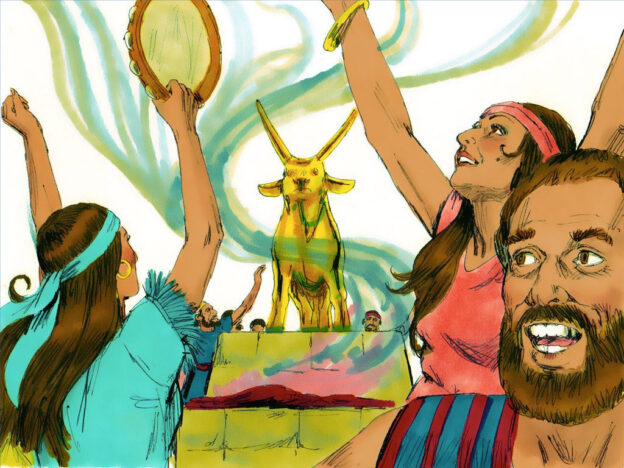
Yet, before long, they made a golden calf. This might have originated from the worship of the sacred bull Apis in Egypt. Since Moses remained on Mount Sinai for forty days and nights, the people grew anxious. They approached Aaron and demanded gods to lead them, explaining, “As for this Moses, the man who brought us up out of the land of Egypt, we do not know what has become of him” (Exodus 32:1). Their crisis began when the person through whom they experienced God’s presence was no longer visible. This physical absence caused doubt in their minds that resulted in anxiety and insecurity.
The wilderness where they were left without Moses was unfamiliar and dangerous. They desired instant solutions for their anxious and insecure minds. However, the core of their mistake was seeking security through something that they were familiar with from the past, an idol that they could create and control. This describes our inner desire for a god who fulfills our expectations, immediately protects us from suffering, and guarantees a comfortable future. When God does not act according to our desire and expectations, we may reshape our understanding of God until it becomes more reassuring to what we want.
In Arcana Coelestia, Emanuel Swedenborg explores the spiritual meaning of the golden calf, connecting it with human intelligence and affection when separated from the inner meaning of divine truth. The golden calf warns us against making our own desires and understanding the ultimate authority in spiritual life. The golden calf invites us to examine what we turn to when God’s presence seems absent. Do we reshape our faith to preserve our comfort, or do we wait for divine truth to reshape us? Anxiety and insecurity may never disappear from our minds while living on earth, yet it does not mean that we turn those feelings into idols. The first step beyond the golden calf is recognizing that our need for immediate solution must not become greater than our willingness to be led by God.
Blessings,
Rev. Junchol Lee