
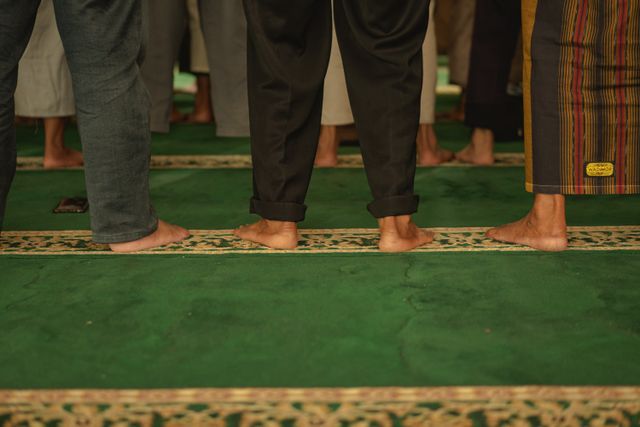
“Do not come near; take your sandals off your feet, for the place on which you are standing is holy ground.”
Exodus 3:5
Dear members and friends,
In life there could be moments when we suddenly realize that we are standing on holy ground, because we acknowledge the presence of God. Moses was tending the flock of his father-in-law Jethro when he came to Horeb, the mountain of God, which was what he had been doing for the past 40 years or so. On this particular day, he saw something strange there: a bush that was burning with fire, yet the bush was not consumed. Moses stopped and turned aside to see this “great sight.” And then God called to him from the midst of the bush:
“Moses, Moses!”
Moses answered, “Here I am.”
God then said, “Do not come near; take your sandals off your feet, for the place on which you are standing is holy ground.”
What makes this scene so remarkable is that nothing about the physical location initially appears extraordinary. Moses is simply going about his ordinary work. Yet suddenly, in the of routine life, he encounters the presence of God. The burning bush becomes a sign of something profound: the Divine can reveal itself in the midst of ordinary life. The bush burns, but it is not consumed. Moses sees something that cannot be explained merely by what his senses tell him. He is being invited to pay attention deeply.
Before Moses can approach, however, he must take off his shoes. Why? At first, this may seem like a strange command. What difference could it possibly make to God whether Moses approaches with sandals on or with bare feet? Surely God is concerned with what is in Moses’ heart rather than what is on his feet.
This is precisely where Swedenborg’s interpretation of the passage becomes meaningful. In Secrets of Heaven, Swedenborg understands the shoes as representing the sensory level of human life: our most outward way of experiencing the world. Our senses are necessary and good; they allow us to live in the world and to encounter physical reality. But they can also become the place from which we understand everything. When we rely exclusively on what we can see, hear, touch, measure, and explain materially, our perception becomes limited to the outermost level of reality. Swedenborg therefore sees Moses’ taking off his shoes as a symbolic act: setting aside the merely sensory perspective in order to approach the Divine.
The command is not really about footwear. It is about perception. More precisely, where and how our perception is attached or bound. Moses must leave behind, at least for a moment, the ordinary way of seeing things. He must become capable of recognizing that there is something more here than what his eyes can see. The burning bush is not simply an unusual physical phenomenon. It is a moment of revelation. This is why the next words are so important:
“The place on which you are standing is holy ground.”
My brothers and sisters in God, let us make time and space for deep prayer this week. Let us invite our minds to acknowledge the presence of God in our daily life routine. Perhaps, we would be able to enter into holy ground.
Blessings,
Rev. Junchol Lee